
Site Preparation for Builders: Blenheim & Marlborough

Before a builder or concrete crew can start, the ground has to be ready: the old slab or shed gone, the topsoil off, the pad at the right height, the section cut level and the trenches in. DirtPro does that site preparation across Blenheim, Renwick and the wider Marlborough region. We are owner-operated and based in Fairhall, and we bring our own digger and tipper truck, so the digging, the cartage and the gravel all happen in the same visit.
Call John on 021 0226 1219 for a free quote, or send a message.
House pads ready for the slab
A house pad has to sit on solid ground. We strip the topsoil and root mat off the building footprint, sub-grade it down to firm, undisturbed ground and cart the soft material away separately so it does not end up mixed into the structural fill. Then we bring the pad back up to the surveyor's heights with imported gravel, compacted in layers so the surface is flat and consistent across the footprint.
On a subdivided section in Renwick, an old garage slab sat right where the new house needed to go. We broke up the slab with the 14-tonne Hitachi, loaded the concrete straight into the tipper, sub-graded the house footprint, stripped the excess topsoil and brought the pad up with gravel to the given heights, all in one mobilisation. When we left, the concrete crew could start boxing for the new slab. The full write-up is on the Renwick slab demolition and site prep page.
For pads and platforms that need to be level, we run a two-way grading laser with a Depth Master receiver on the digger arm, so John can see from the cab how far he is above or below grade. More on that in how we use laser levelling.


Section cuts and building platforms
On a sloping section, the flat ground for a house or an extension has to be cut out of the hill, and the material has to go somewhere. Where we can, we use the cut to build up the fill side so nothing has to be carted away.
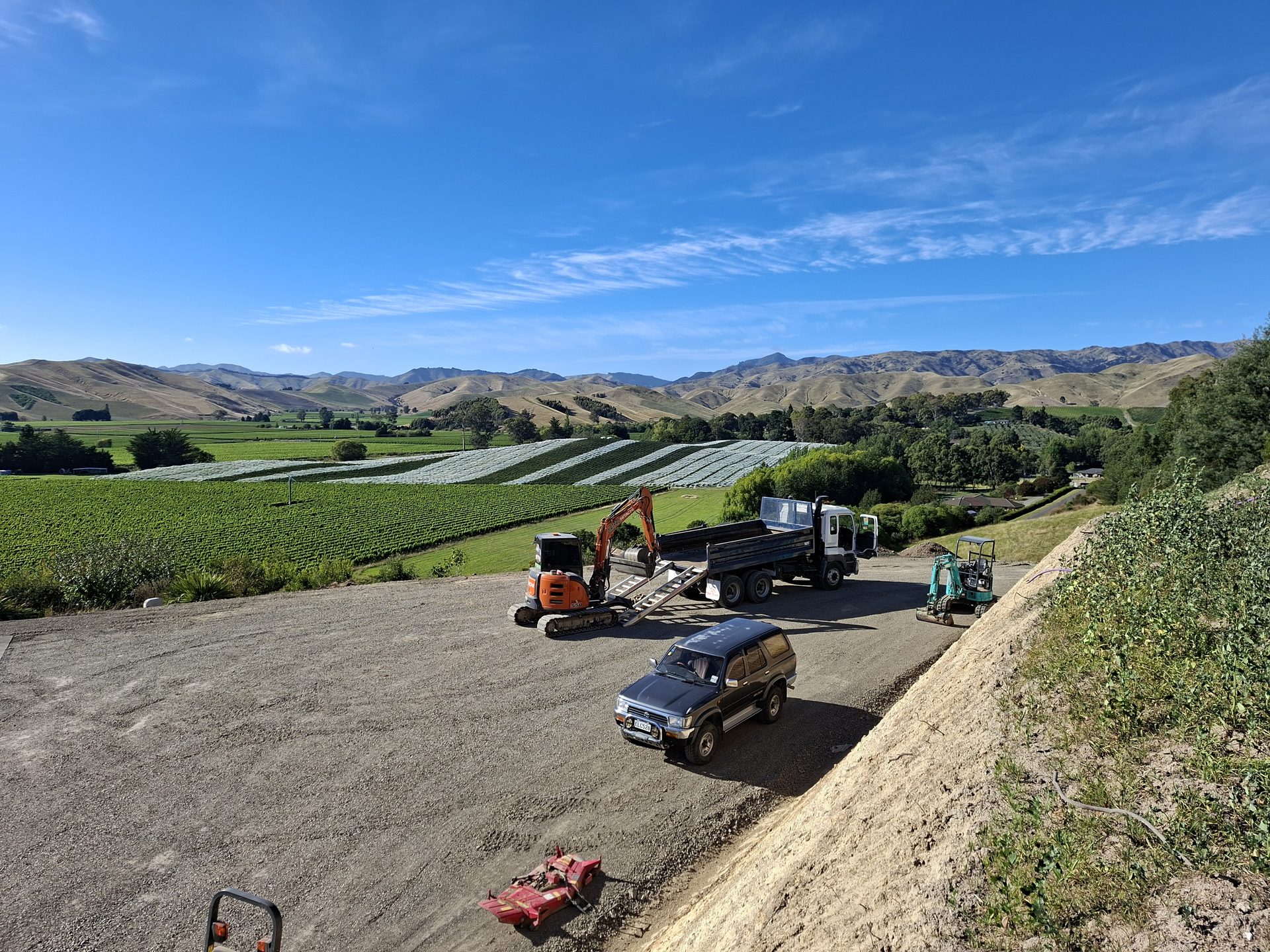
At Morven Lane in Blenheim, a homeowner needed flat ground on a steep hilltop section to extend their home. Over about two months we moved close to 3,000 cubic metres with the 14-tonne Hitachi, the mini excavator and our Isuzu tipper, and built a 1,000 m² platform for the extension. Every cubic metre of cut was reused in the fill, and the platform was shaped to shed water on its own rather than needing a formal drainage system. After the bulk earthworks, we spent a further three weeks trenching services and spreading gravel across the cut area to get it ready for construction. See the Morven Lane cut and fill project for the photos and the story.
Bigger cuts, steep slopes and work near streams can need a resource consent from Marlborough District Council. We are not planners, but we will flag likely consent issues when we quote. There is more on this on our earthworks page.


Foundations and service trenches
We dig foundations for new builds and extensions, and the trenches for water, power, drainage and fibre runs across residential and rural sites. Drainage and stormwater trenches need a steady fall, which is where the grading laser earns its keep: fewer low spots, less over-digging and less fill brought in to make up the difference.
Our everyday digger is a 5.5-tonne mini excavator, small enough for tight residential sections and standard gates, and we bring in the 14-tonne Hitachi when a job needs it. The digger hire page has the full list of gear.
Clearing the site first
Most sites need something taken away before the building work can start. We handle that as part of the same job:
- Old slabs and concrete, broken up, loaded and carted away for recycling at a local crushing yard instead of the tip. See concrete breaking and removal.
- Sheds and other structures, taken down and carted away. See our demolition work.
- Topsoil, stripped off the building area. It can be carted away or stockpiled on site if you want it for the garden later.
- Stumps, pulled out whole with the digger, roots and all, and the holes backfilled.
On a lifestyle block at Bush Road, Tuamarina, we stripped the topsoil off the footprint of a new gravel pad down to firm subgrade, stockpiled the topsoil for the owner's gardens and pulled out three big stumps and a few small ones in the same visit. The owner spread his own gravel afterwards. Read the Tuamarina topsoil and stump removal job.


Smaller pads: spa pools, water tanks and sheds
Not every pad is for a house. We also build gravel pads for sheds, containers, parking areas, spa pools and water tanks.
On a Blenheim property we built a level pad for a spa pool beside the house, and stripped the topsoil around the back to keep the weeds down, over three days with the mini excavator. The tricky part was getting the gravel in: the truck had to park in the neighbour's driveway, and the digger reached over a 1.8 metre fence to place the material.
Near Renwick, a property needed a solid, level base for two 25,000-litre poly water tanks. Over two days we cut and built up the ground to a level platform, dug down to a hard subgrade and laid gravel for a stable, free-draining base. Getting that base right matters: an uneven or poorly prepared pad can make large poly tanks deform or fail over time, especially once they are full.
Working to your plans
We work as a sub-contractor for other contractors around Marlborough, so working to someone else's plans and heights is normal for us. You deal with John from the quote to the finished pad: he walks the site, runs the machine and tidies up. Having our own truck on site means spoil goes out and gravel comes in without waiting on a separate cartage company.
Getting a quote
Quotes are free and no-obligation. Most jobs need a quick site visit to look at access, the ground and the heights you need, and we usually get a quote back to you the same day. We do not list rates online, but we charge competitive hourly rates and our quotes are transparent. Call John on 021 0226 1219 or send a few details through the contact form.
Related projects


Got a section to get ready for the builder? Call John on 021 0226 1219 for a free, no-obligation site visit and quote, or send a message with a few photos and the plans.
Get a Free Quote